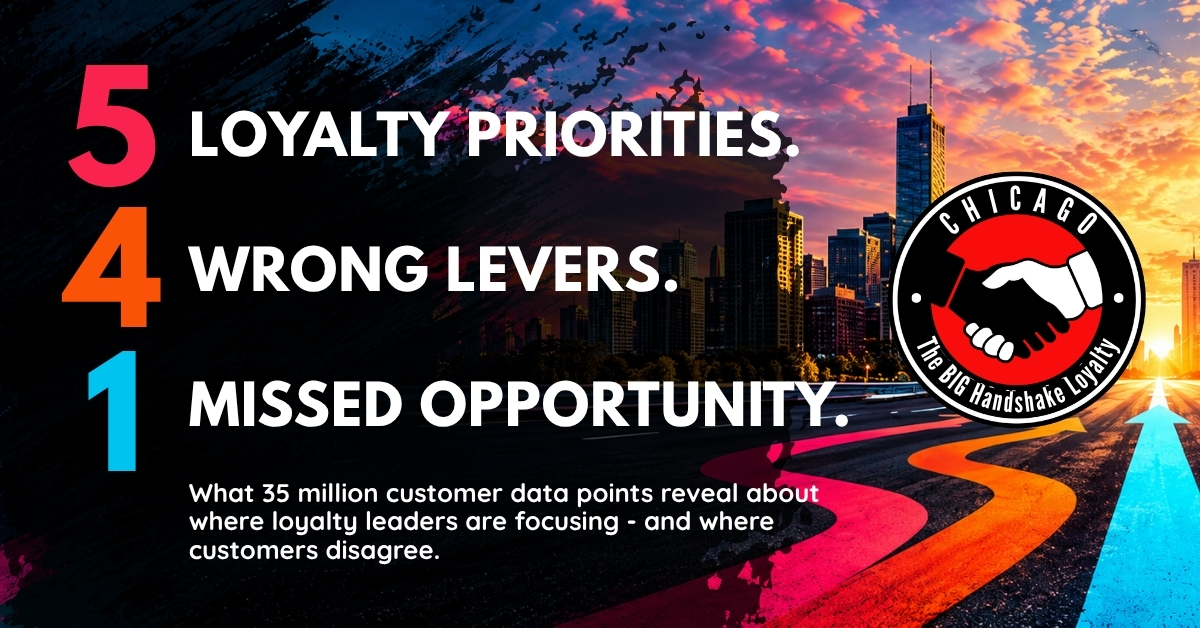
When we asked the loyalty leaders coming to The BIG Handshake (TBH) Loyalty™ in Chicago what they’re focused on this year, we ended up with a tidy list of priorities. We’d also been working through Bond’s 2026 Loyalty Report (our amazing sponsor), which draws on 35 million data points about how people actually behave. One list is what practitioners say they want to do. The other is what customers went and did. In four out of five cases, the room is aiming at the right thing and reaching for the wrong lever. The fifth is a genuine opportunity that hasn’t fully landed, and it needs to be prioritized.
Retention: Everyone Wants it, Few Earn it
Retention topped the list among TBH Loyalty Chicago attendees. More than eight in ten (83%) named it as their big goal for the year. Not surprisingly, the customer data backs the instinct, with consumer intent to stick with a brand sitting at a five-year high, around 85%. The trouble shows up when you look at how individual programs actually perform on keeping people, which lands well below that, at roughly 39%. Intent is not a reason to come back.
The lever most programs underuse is redemption. Bond’s wallet data shows a member spends up to 1.5 times more than a non-member, but a member who actually redeems a reward spends up to 2.1 times more. That gap between earning and redeeming is where retention is quietly won or lost. For the customer, it’s the difference between points that expire unnoticed and a free night that makes the whole program feel worth it. And the commercial logic is hard to argue with: a redeemer is worth nearly double a passive member, so the moment someone cashes in a reward isn’t a cost to manage; it’s the growth event to build around.
Great Wolf Lodge is the example we showcase, and Dave Van Saun will be talking about it in Chicago. Think about the math of an indoor water park. A family shows up once, maybe twice a year if you’re lucky. You cannot build a habit on that. So Great Wolf stopped trying to manufacture frequency and poured its energy into the visit itself, and the perks members actually redeem, so valuable that the next booking feels obvious. Low frequency, high feeling. If a brand people see twice a year can pull that off, the rest of us have fewer excuses.
Engagement, or the Illusion of it
Engagement was the obvious one. Attendees named it as both a top goal (56%) and their single biggest headache (46%), which already tells you something. Bond has a number that explains the frustration: the average person belongs to about twenty loyalty programs and is active in only half of them. So a lot of the “engagement” we congratulate ourselves on is people half-noticing a pile of programs they’ve mostly forgotten. Opening an email isn’t loyalty.
Two of our Chicago sessions land on opposite sides of this, on purpose. The Cleveland Cavaliers and Blings will show how one well-built email pulled roughly eight interactions out of each fan, because it treated people like participants instead of a mailing list. Then Audience Rewards gets up with a talk called “Fandom Isn’t the Finish Line,” and the title is the whole argument. Broadway has some of the most devoted fans alive, and loving a show still isn’t the same as buying a seat. Both things are true, which is exactly why we wanted them in the same room. The trap for a brand is spending real money to lift a number that never touches revenue. So the question worth chewing on is whether your engagement turns into people staying and spending, or whether it just keeps everyone busy and the dashboard green.

Personalization Only Works if They Trust You
Personalization came in second among attendee priorities (52%), and it sat near the top of the challenge list too. Here’s the part people skip. Bond found that “feeling valued” has been the number one loyalty driver four years running, and that how you handle someone’s data is climbing fast as a factor in whether they trust you at all. The encouraging news is that the trust is mostly there to be earned: nearly nine in ten consumers say they’re comfortable having their information shared between a program and its partners, when it’s handled well.
Sephora, who’ll be there in Chicago, gets this right. When Beauty Insider recommends something, it feels like a brand that knows you because you let it in. Send the same message without that trust, and it feels like being followed. Bond draws a hard line between what it calls artificial loyalty, the kind run by systems and scale, and the emotional kind, built on genuinely being recognized. To a member, that’s the whole distance between “they get me” and “they’re watching me.” Get it right, and a flywheel starts: people who feel recognized share more, which makes the next offer sharper. Get it wrong, and they quietly close the blinds. Otherwise you’re just being creepy at scale.
AI: Right Idea, Wrong End of the Journey
AI was the thing most of the room is shopping for, with 41% actively evaluating it, ahead of everything else, and customers agree it’s worth doing. Roughly seven in ten (71%) say AI can make loyalty better. What most brands get wrong is where they put it. They bolt it onto service and support, which is where it starts to feel like a wall between the customer and an actual human. The value is upstream: Bond found that about two-thirds of the AI moments people actually value happen in discovery and evaluation, when someone is trying to decide.
Microsoft, with Danielle Yedinak presenting in Chicago alongside Bond, is building toward that earlier moment, using CRM data and the information customers actually choose to share to make the program smarter before the purchase rather than after the complaint. To a customer, good loyalty AI feels like a knowledgeable concierge at the point of decision, not a chatbot standing between them and a refund. Put it in the wrong place, and you slowly train people to dread contacting you, which is a strange thing to spend money building. People don’t want to admire your AI. They want the program to understand what they’re trying to figure out and help them do it. Aim it at the decision, not the support ticket.

Partnerships: The One that Should be Prioritized
This is the gap that surprised us most. Barely one in six registrants (17%) is looking at partnerships or omnichannel, and partnerships didn’t crack the priority list at all. Meanwhile, Bond calls partnerships the growth engine hiding in plain sight. Among people who know about a loyalty partnership, three in four are actively using it, and linked partnerships move real money- between 17 and 38% more in annual spend, or roughly $54 a month. The barrier isn’t that people dislike them. It’s that nearly half of those who haven’t activated simply forgot the benefit was there.
bp, with Alyssa Callahan speaking in Chicago, runs an ecosystem across fuel, convenience, and partner rewards, and the growth doesn’t come from signing more partners. It comes from putting the ones they already have in front of people at the pump or the coffee counter. Bilt, also in the room, built an entire company on the same trick, turning rent, of all things, into a web of partner value. For the member, an activated partnership means everyday spending quietly goes further with no extra effort. For the brand, it may be the cheapest growth on the table, because the proposition already works and the only real fix is reminding people what they have. None of this is invention. It’s activation.
So What?
Step back and the five findings rhyme. As an industry, we spend most of our effort at the front door: sign-ups, activity, reach. Customers reward what happens deeper in, when they redeem something, feel recognized, or finally use a partnership they’d forgotten about. The programs pulling ahead this year aren’t the ones with the biggest member counts or the longest feature lists. They’re the ones getting people to redeem, to feel something, to trust, and to actually use what they have.
The good news is that nobody needs convincing that loyalty matters anymore. That argument is won. The real work now is closing the distance between what we’re building and what our customers keep telling us they value. That’s the conversation we’re having at The BIG Handshake Loyalty in Chicago on November 10, with the people behind Great Wolf Lodge, the Cavaliers, Microsoft, bp, Sephora, and plenty more in one room digging into these exact gaps. If this is your world, this is your room. Reserve your seat here.