
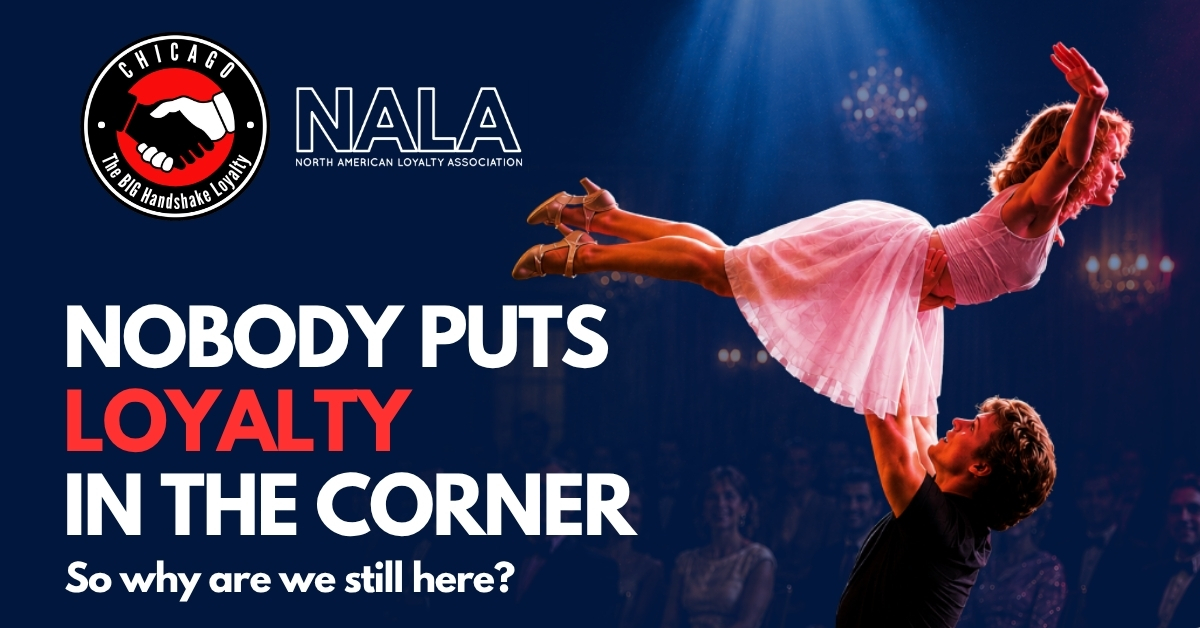
We drive retention, revenue, and relationships. So why are we still being sidelined?
Nobody puts Baby in a corner. And nobody should put loyalty there either.
And yet, loyalty teams are often the last to be invited into the strategy conversation and the first to be removed from it. Not because our results are weak. Because our results are invisible. Customers are retained. Spend is up. Churn is quietly, invisibly, being prevented. Everything is fine. And when everything is fine, no one thinks to ask who made it that way.
This is the loyalty paradox. We are the most measurable function in the building. We can show you retention rates, incremental spend, lifetime value, revenue lift. We track everything. And because we track everything, we are easy to take for granted. The impact of our absence doesn’t show up on a dashboard until it’s too late. Customers don’t leave dramatically. They just quietly stop coming back. Engagement erodes. The relationship thins out. And by the time anyone notices, the damage compounds in ways that take years to undo.
This is the conversation The BIG Handshake (TBH) Loyalty has been building toward. At TBH Loyalty Toronto this past April, nearly 200 loyalty professionals from 80 companies spent a full day on exactly this question: why does a discipline with results this clear still struggle to claim its seat at the table? At TBH Loyalty Chicago on November 10, Alyssa Callahan of bp will take it further. Drawing on her experience across Wyndham, L’Oréal, and bp North America, she will explore the organizational friction nobody talks about openly: why loyalty keeps getting pushed to the edges of commercial decision-making, and what it actually looks like when it finally gets the seat it deserves. See the full speaker lineup here.
We Earned This Seat. We Just Haven’t Claimed It.
According to the 2026 Bond Loyalty Report, 85% of consumers are more likely to keep doing business with a brand that offers a loyalty program, and 73% of members spend more as a result.
These are not soft metrics. These are the numbers that belong in a boardroom, in a growth strategy conversation, in the meeting that shapes next year’s priorities before loyalty even gets invited to present.
No one thinks longer-term than a loyalty professional. We are trained to think in relationships, not transactions. In tenure, not traffic. In lifetime value, not last quarter. That is not a soft skill. That is a strategic capability that most organizations desperately need and chronically undervalue.
The seat at the table is not something we need to ask for. It is something we have already earned. The question is why we are still standing in the hallway.
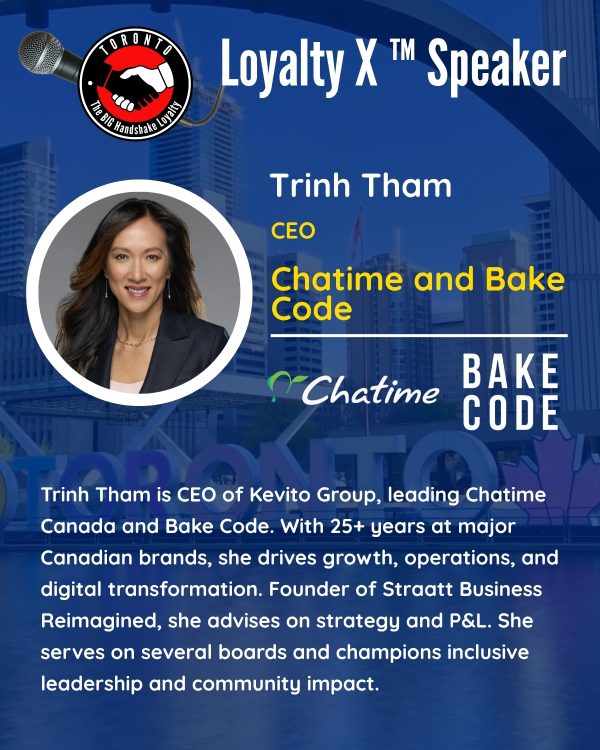
What the CEO Side of the Table Actually Sees
At TBH Loyalty Toronto in April this year, Trinh Tham, CEO of Chatime Canada, delivered the kind of talk that makes a room go quiet.
No slides. No framework. Just candor.
Trinh spent most of her career building loyalty programs at Loblaws, Tim Hortons, Sobeys, and Harry Rosen. She knows what good work looks like from the inside. Then she became CEO. And the view changed completely.
“As a marketer, I thought about engagement, I thought about emotional connection, I thought about lifetime value,” she told the room. “As a CEO, I think about revenue growth, risk, speed, EBITDA.”
She shared three moments that showed her exactly where the gap lives.
A simple, almost embarrassingly tactical campaign got more attention than her most sophisticated program, because it connected directly to a live business priority. Alignment, she learned, beats elegance every time.
Her most carefully designed work sometimes never left the marketing org. Not because it was wrong. Because it required too much explanation. If the impact is not immediately clear, it stays in marketing. The boardroom does not have time to be educated.
And in one case, a fully built program reached the boardroom only to find that the business had already moved on. The work was not wrong. It was just no longer aligned. Loyalty, she said, has to move at the speed of the business or it misses the window entirely.
None of this is an indictment of loyalty. It is an indictment of the gap that exists between what we know and what leadership hears. A gap that keeps us in the corner. A gap that is ours to close.
“Stop trying to prove that loyalty works,” she told the room. “Start making it impossible to ignore.”
That is not a communication tip. That is the key to the seat at the table.
The Seat Is Waiting
The seat at the table belongs to the team that understands the customer better than anyone else in the building and can translate that understanding into growth. That is us. It has always been us.
Too many brands still treat loyalty as something adjacent to the customer experience rather than part of the brand itself. The result is disconnected campaigns, fragmented customer journeys, and loyalty teams constantly fighting for influence internally. And as loyalty programs become valuable assets for media, targeting, and revenue goals, there is a quiet pressure to optimize for data extraction over relationship. The program stays intact. The trust erodes. And loyalty gets pushed further into the corner.
Trinh closed her talk with a question she left hanging in the air: when was the last time a loyalty initiative actually made your organization change a decision, not just a presentation, but a real decision?
That is the version of loyalty that earns the seat and keeps it. Not by proving it works. By becoming impossible to leave out. As the famous line from Dirty Dancing reminds us: “Nobody puts Baby in the corner.”
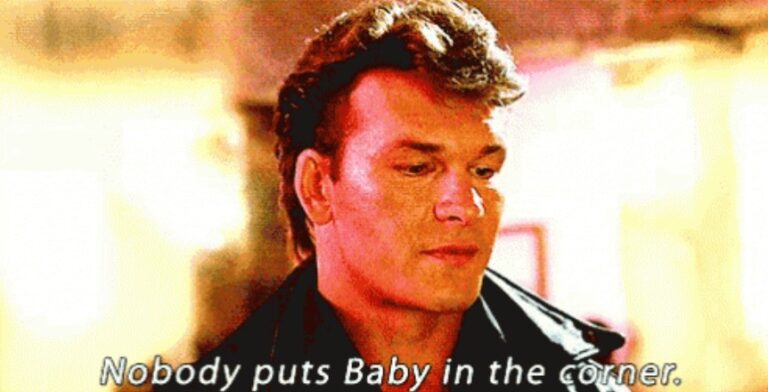
For much of the film, Baby is underestimated. Only at the end does everyone realise the value she brought all along. Loyalty is often in the same position. Quietly building stronger relationships, protecting revenue and shaping customer behaviour while the credit goes elsewhere. The question is whether the rest of the organisation realises it before it’s too late.
At TBH Loyalty Chicago on November 10 at the Omni Chicago Hotel, Alyssa Callahan of bp will take this conversation further. What does it look like when loyalty stops being adjacent to the brand and becomes part of it? How do you push back when the pressure to monetize customer data starts quietly reframing what your program is actually for? And how do you walk into a boardroom not as the team that runs the points program, but as the team the business cannot afford to leave out of the room?
Register now for TBH Loyalty Chicago and claim the seat that was always yours.
NALA is the North American Loyalty Association. TBH Loyalty Chicago takes place on November 10 at the Omni Chicago Hotel.
