
Loyalty programs in Canada are caught in a vice. Consumers are leaning on points and rewards more than ever, using them as a financial vehicle to subsidize everyday expenses in a high-cost environment. At the same time, corporate budgets for those same programs are shrinking, leaving marketers responsible for delivering more value with fewer resources.
Partnerships have emerged as one of the most compelling responses to that pressure. Not co-branded credit cards or the occasional cross-promotional email. Strategic, multi-year, customer-centric partnerships that expand what a program can offer without requiring the brand to carry the full cost alone.
No one in the Canadian market has moved more decisively in this direction than Canadian Tire. Over the past two years, Triangle Rewards has announced partnerships with Petro-Canada, WestJet, RBC, and Tim Hortons, building what Josh Meyer, AVP Loyalty Partnerships at Canadian Tire, describes as a loyalty flywheel. The idea is straightforward: customers earn Canadian Tire money across a growing network of partners, generate more data in the process, engage more deeply with offers, and return to redeem. Then the cycle begins again.
“Customers expect their loyalty programs to be continually working hard for them,” Josh said, “and not just resting on traditional ways that they have provided value in the past.”
Canadian Tire traditionally grew through retail acquisition, including Sport Chek, Mark’s, and Party City. Loyalty Partnerships unlock many important categories that Canadian Tire does not play in today.
“The next logical step in providing relevance in terms of places to earn and ways to engage customers is going outside of our own enterprise,” Josh said.

The results are starting to show. Canadian Tire is roughly two years into its Petro-Canada partnership and has been candid about what it is seeing. Customers who engage with the Petro-Canada partnership subsequently spend more at Canadian Tire retail banners, with over $100 million in incremental sales already. That is not correlation, Josh is careful to point out. That is causality, proven through statistical incrementality testing.
“It has proven our hypothesis,” he said, “and certainly gives us a lot of confidence as we move forward with our other partners.”
RBC launched at the end of October, ran a significant media push in January, and early participation numbers are tracking ahead of expectations. WestJet and Tim Hortons launches are fast approaching. While it is early days, and proving incrementality requires months of data, Josh says the trajectory is encouraging, particularly around the experience of linking accounts, which some in the industry have flagged as a friction point.
“The idea of linking itself is not a barrier,” he said. “But you still have to prove to customers that it is worth their time and effort, and you have to have a very clear and concise message about why they should care.”
What makes Canadian Tire’s model distinct from traditional coalition programs is that it preserves brand ownership on both sides. Customers earn Canadian Tire money and partner currencies simultaneously, rather than pooling into a shared currency. It is what Grimberg calls an “and” proposition rather than an “or” proposition: instead of asking customers to choose one currency, the model gives them both.
“We are only giving customers the option to earn more,” he said, “and that is certainly well received in the current economy.”
That framing matters beyond the consumer experience. It also matters internally. One of the most underappreciated challenges in building loyalty partnerships, Josh argues, is organizational readiness. Not technology, not budget, not even partner selection. Readiness.
“Companies really need to be ready to embrace partnerships as a core pillar of their loyalty and customer strategies,” he said. “It takes a lot of investment, resources, and organizational alignment. It is not a small feat to bring these off the ground.”

That readiness requirement cuts both ways. A prospective partner also needs to be ready, and timing on both sides has to align. Josh adds another layer that many brands overlook entirely: in Canada’s increasingly interconnected loyalty landscape, you need to map not just who your partners are, but who their partners are, and what conflicts or complementary effects might arise from those broader networks.
For smaller brands without Canadian Tire’s scale, the advice is less about size and more about strategy. Josh suggests that mid-market and smaller companies look beyond traditional marketing list arrangements and focus on genuine value creation opportunities.
“A strategic relationship that is multifaceted, potentially with loyalty at the core, may serve to be more beneficial,” he said. “Value creation opportunities exist within enterprises of all sizes..”
The KPIs evolve as a partnership matures. Year one is about awareness, linking, and a successful launch. Years two and three are where the work shifts: fine-tuning promotions, personalizing offers, and identifying the areas of opportunity that did not make it into the first year’s roadmap. The goal is not a one-time behavioral lift. It is a permanent shift in shopping habits.
“It is around building routine and habits,” Josh said, “and not just incentivizing the one-time additional shop, but causing a change in their perceptions and their shopping habits long term.”
That is the ambition behind the flywheel. Not a campaign. Not a promotion. A structural change in how customers think about where they shop and what they earn.
For brands still deciding whether to leap, Josh’s counsel is clear-eyed.
“Partnerships are not for the faint of heart,” he said. “They can be hugely impactful, but it is an organizational muscle you have to build. You get out what you put in. The results, I think, speak for themselves.”
Hear It Directly From Josh Meyer
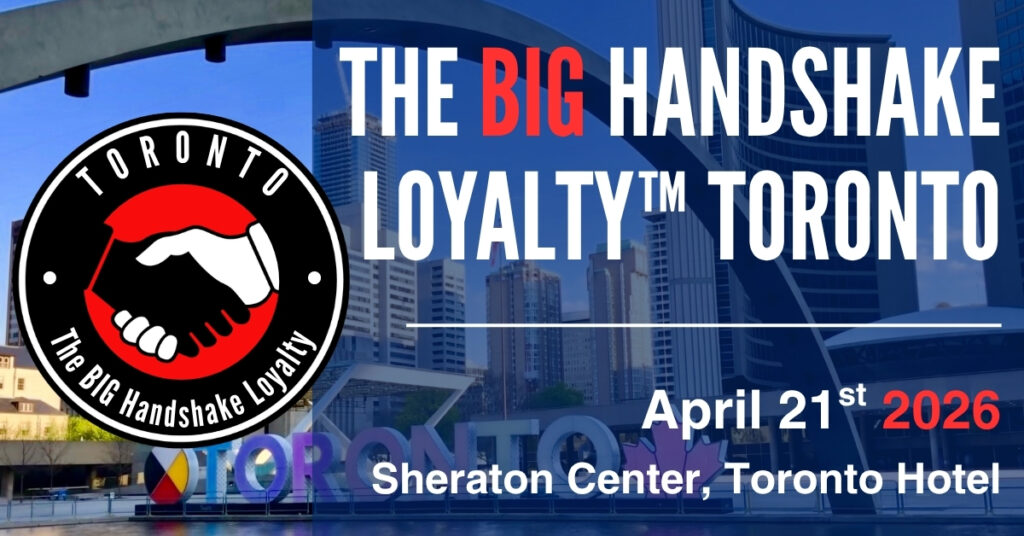
Josh Meyer will be a keynote speaker at The BIG Handshake LoyaltyTM Toronto, taking place on April 21 at the Sheraton Centre Toronto. He will share how Canadian Tire is redefining loyalty through partnerships, including what the flywheel strategy looks like in practice and where it is headed next.
The event is open to senior brand-side loyalty marketers. Registration is available at: https://www.tbhtoronto.com/#/tickets?lang=en
