Say what you want about FIFA. (And there’s plenty to say.)
But the 2026 World Cup, that kicked off in June in North America for the very first time, is one of the most instructive loyalty case studies on the planet. And as loyalty professionals, we’d be remiss to let it pass without taking notes.
No points currency. No app. No tier structure. Just billions of people who showed up four years ago, and showed up again.
The numbers are hard to argue with
FIFA’s 2022 tournament engaged 5 billion people across all media platforms. The Argentina–France final drew 1.42 billion viewers, the largest single-event audience ever recorded in broadcasting history. And despite ongoing controversy, inconvenient time zones, and a global cost-of-living squeeze, FIFA is projecting 6 billion people will engage with 2026. The audience keeps growing.
That kind of repeat engagement, cycle after cycle, is what loyalty programs spend billions trying to replicate.
What the World Cup gets right
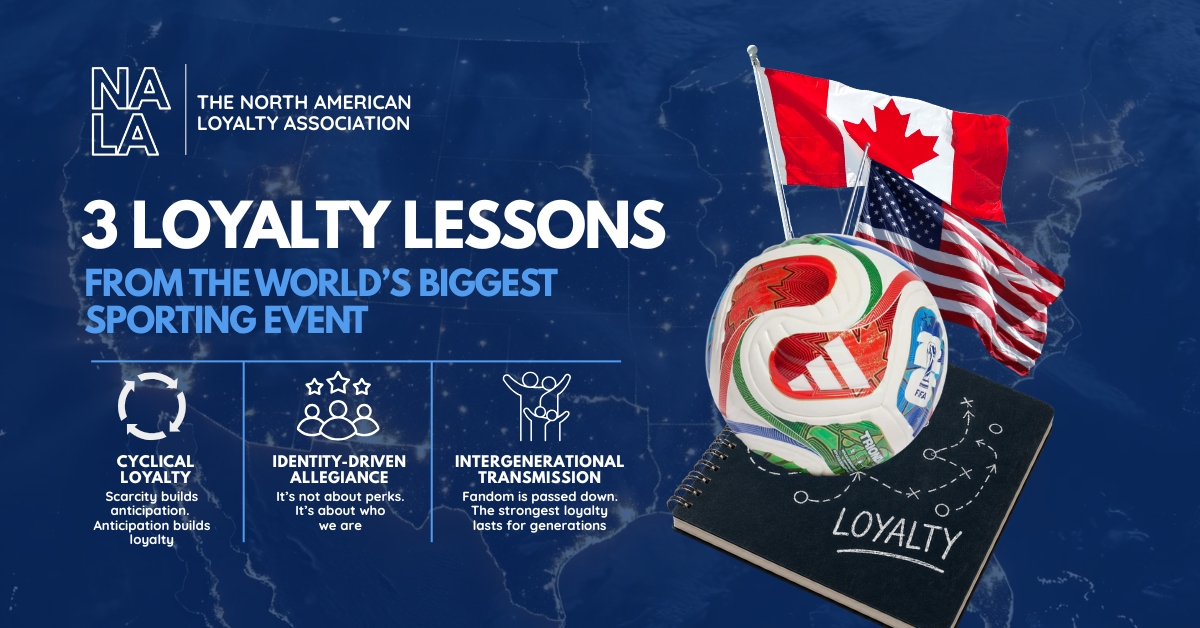
Cyclical loyalty. The four-year cadence creates scarcity and anticipation that no always-on program can manufacture. People miss it. They wait for it. They mark their calendars years in advance. Most loyalty programs are designed to be frictionless and ever-present, but the World Cup reminds us that absence can be a feature, not a bug.
Identity-driven allegiance. Research from a December 2024 survey of over 2,000 American fans found that nearly a quarter support one country exclusively. Not because of perks, but because of who they are. Heritage, family origin, national pride. That kind of allegiance doesn’t erode when a competitor launches a better offer. It’s the loyalty every program director is ultimately chasing.
Intergenerational transmission. Fandom is inherited. Parents pass it down. Kids grow up rooting for the same team, watching the same tournament, feeling the same thing their parents felt. The strongest loyalty programs work the same way, becoming part of a family’s habits rather than just one individual’s routine.

Where it breaks down
The flip side is also instructive. Research from Adlook across six markets found that 64% of World Cup viewers are casual fans, and more than half stop watching the moment their national team is eliminated. Strip away the identity connection, and the loyalty disappears fast.
That’s the cliff every program faces when its value proposition is purely transactional. When earn-and-burn mechanics are the whole story, members leave the moment a better offer comes along.
What brands in retail, financial services, and travel are learning from this
The best loyalty programs are starting to borrow from the World Cup playbook. Not by copying the format, but by understanding what drives the emotional connection underneath it.
In retail, the opportunity is hiding in plain sight. Foot Locker redesigned its FLX Rewards program in 2024 around the power of anticipation, giving members priority access to upcoming sneaker launches and a “Heat Monitor” to track pre-launch hype. The product is still the reward, but the program makes the waiting an experience in itself. Then there’s the shared experience angle, which most retail loyalty programs barely scratch the surface of. Nordstrom’s Nordy Club hosts member events and offers dining and spa experiences for members and their guests. A Mother’s Day brunch is the obvious expression of that, but that thinking shouldn’t be reserved for one Sunday in May. A mom and daughter shopping together for the first time. A grandmother and granddaughter picking out something special. A parent buying their teen KT by Knix period underwear, a genuinely loaded moment that a smart retailer could make warm and memorable rather than just a transaction. These are the moments that create customers for life, and they happen in stores every single day. Most loyalty programs are completely blind to them.
In financial services, American Express has long understood that the deepest loyalty is identity-based. The “Member Since” date on every card isn’t just a detail. It’s a deliberate signal that membership is a relationship, not a transaction. Cardholders internalize it. People talk about how long they’ve been members the same way fans talk about how long they’ve supported their team.
In travel, British Airways built something genuinely clever into its Executive Club with the Travel Together Ticket. Cardholders who hit a spending threshold each year earn a companion certificate that can be used to bring someone along on a reward flight, including in business and first class, paying only taxes and fees for the second seat. For a lot of families, that’s how a child gets their first experience in a premium cabin. It’s the kind of memory that creates a loyal traveler for life, not just a repeat booker.
The bigger question
The World Cup draws billions of viewers despite its governing body’s well-documented problems. It survives all of that because the emotional connection runs deeper than the product experience.
Most loyalty programs don’t have that luxury, and they shouldn’t need it. But the question worth sitting with is: what does your program connect to that is bigger than the transaction? What would make a member say “I’ve been with them for years” with the same pride someone says “I’ve supported this team my whole life”?
This month, the World Cup comes to North America for the first time. And this November, The BIG Handshake Loyalty™ comes to Chicago for the first time. Two debuts on the same continent, in the same year — and both centered on the same fundamental question: what makes people show up, stay, and bring others along with them?
Come talk about it in Chicago. November 10, Omni Hotel.